
Overview
A strong understanding of skeletal structures is fundamental to orthopedic diagnosis, surgical planning, and rehabilitation strategy. However, traditional atlases, plastic models, and cadaveric labs often limit spatial comprehension and repeatability.
This case study outlines how we developed an advanced skeleton anatomy VR platform tailored for hospitals, orthopedic departments, medical universities, and rehabilitation centers. By integrating immersive human skeleton VR simulation with structured skeletal system VR training modules, we created a clinically accurate and scalable digital learning ecosystem.
The skeleton anatomy VR solution empowers orthopedic surgeons, residents, and medical students to explore complex bone structures, joint mechanics, and fracture patterns in a safe, interactive, and measurable environment.
Project Requirement
The client required a next-generation skeleton anatomy VR platform capable of:
- Delivering high-precision 3D visualization of the axial and appendicular skeleton
- Providing layered human skeleton VR simulation with muscle and ligament overlays
- Supporting orthopedic case-based skeletal system VR training modules
- Enabling instructor-led classroom and simulation lab sessions
- Integrating performance analytics for academic evaluation
- Demonstrating fracture classifications and joint biomechanics
The primary objective was to design a clinically validated skeleton anatomy VR system that enhances spatial understanding, improves procedural confidence, and aligns with orthopedic training standards.
Project Planning
Our planning phase focused on anatomical accuracy, curriculum alignment, and institutional scalability. We collaborated with orthopedic surgeons, anatomy professors, and rehabilitation specialists to ensure the skeleton anatomy VR modules reflected real-world clinical applications.
Key planning initiatives included:
- Structuring progressive skeletal system VR training modules for students and advanced residents
- Designing interactive human skeleton VR simulation layers for bones, joints, and ligaments
- Integrating orthopedic pathology cases within the skeleton anatomy VR platform
- Ensuring compatibility across VR headsets and university simulation labs
- Building assessment dashboards for measurable learning outcomes
This approach ensured that the skeleton anatomy VR system met both academic depth and surgical precision requirements.
Project Process & Execution
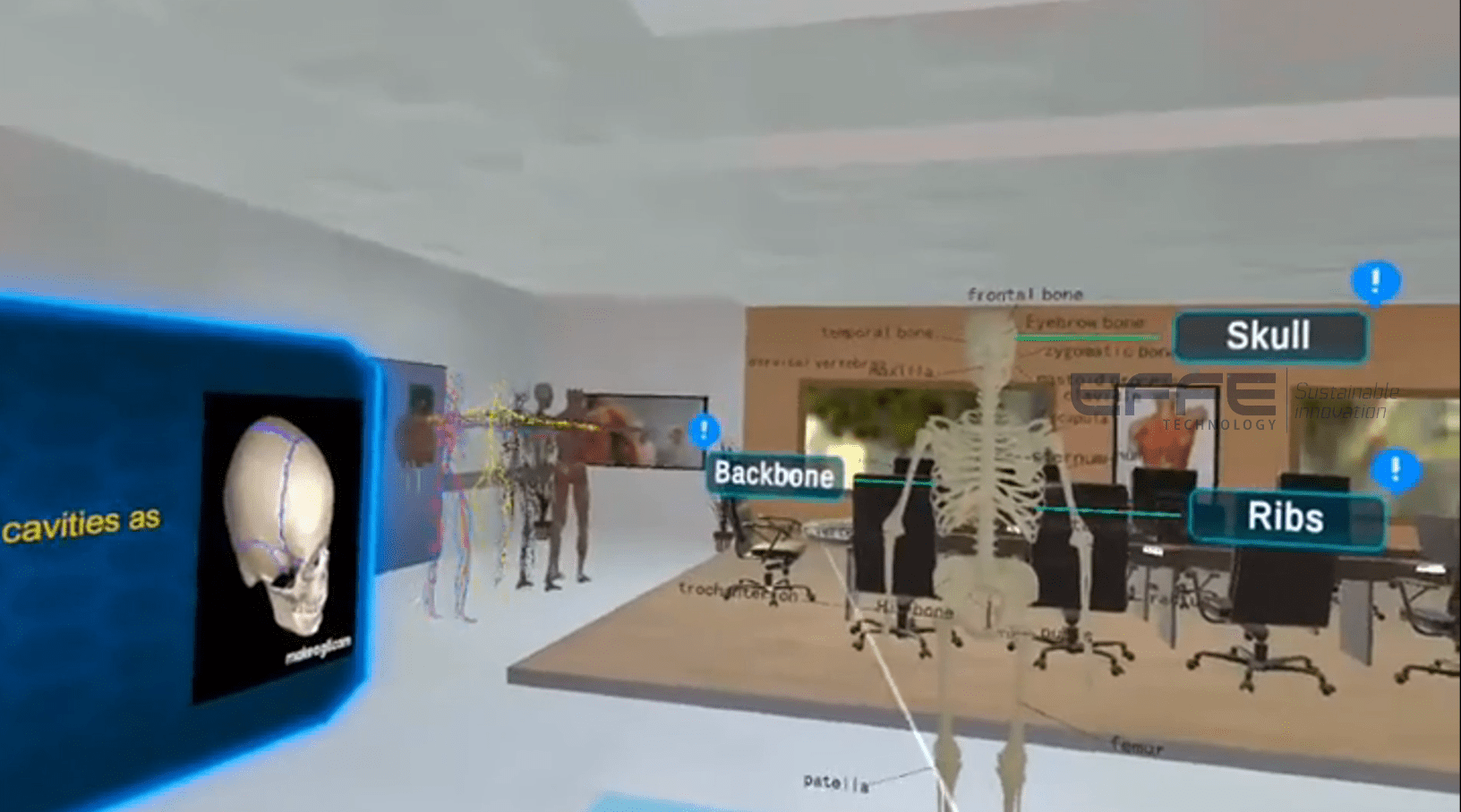
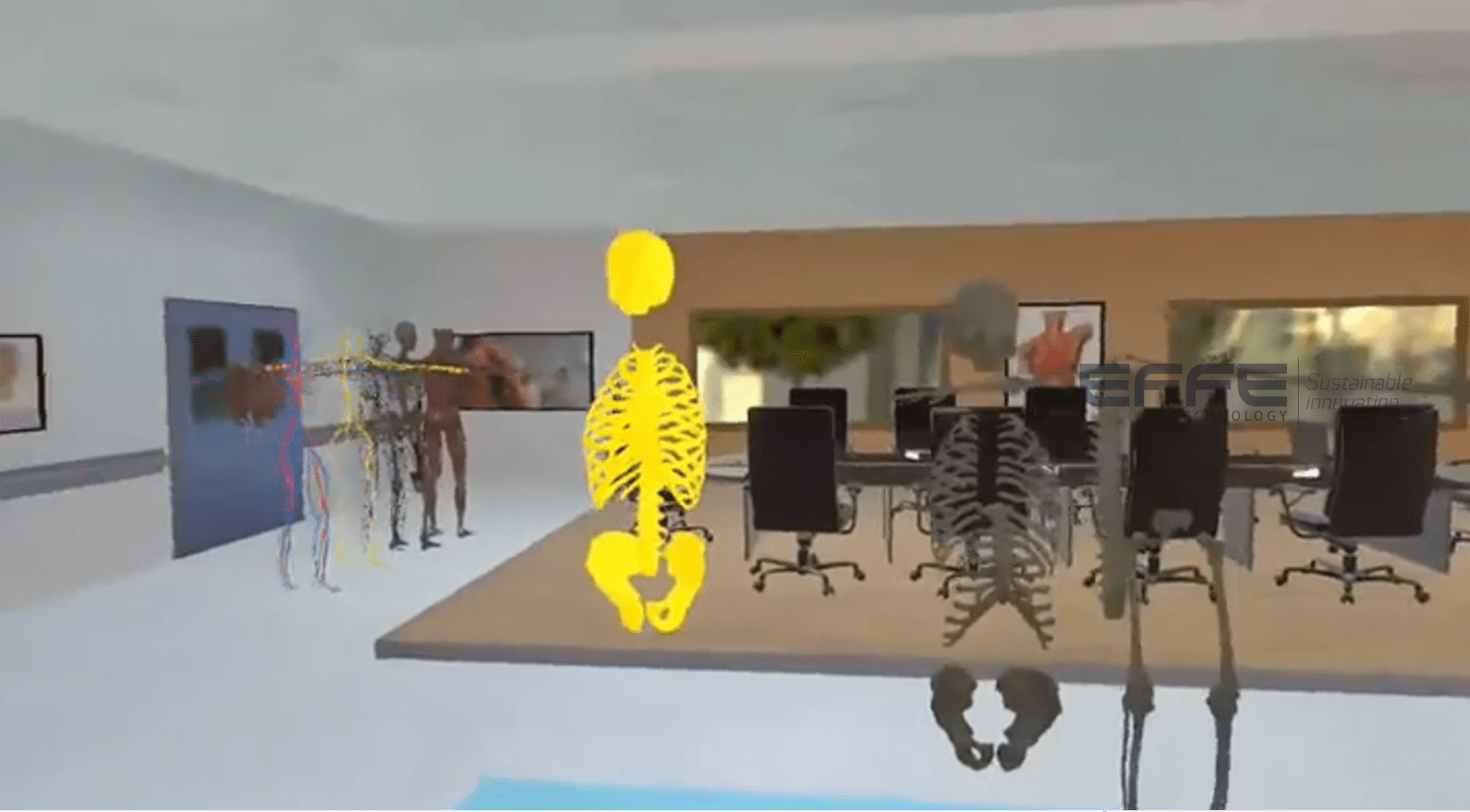
Using high-resolution CT datasets and advanced 3D reconstruction technologies, we developed a fully immersive skeleton anatomy VR environment. Each bone—from vertebrae to phalanges—was modeled with anatomical accuracy and realistic proportions.
Inside the platform, users can:
- Explore the complete skeletal framework in 360° immersion
- Interact with layered human skeleton VR simulation tools
- Isolate bones, rotate joints, and analyze biomechanical movement
- Practice fracture identification through structured skeletal system VR training modules
- Compare normal anatomy with orthopedic injury scenarios
- Participate in instructor-guided collaborative sessions
The skeleton anatomy VR interface allows learners to zoom, dissect, and virtually “assemble” skeletal components, strengthening spatial memory and diagnostic confidence.
Integrated analytics track module completion, engagement duration, and assessment accuracy—providing hospital administrators and education managers with measurable performance data.
Challenges & Learning
Anatomical Precision: Modeling complex joint articulations within the skeleton anatomy VR platform required multiple validation cycles with orthopedic experts.
Biomechanical Accuracy: Simulating movement within the human skeleton VR simulation demanded realistic joint mechanics and rendering optimization.
Diverse User Levels: The skeletal system VR training modules were designed to support both first-year medical students and advanced orthopedic surgeons.
These refinements strengthened institutional trust, long-term adoption, and clinical reliability.
Client Deliverables
- Fully immersive skeleton anatomy VR training platform
- High-fidelity human skeleton VR simulation modules
- Structured skeletal system VR training curriculum
- Orthopedic fracture and joint mechanics scenarios
- Multi-user instructor dashboard
- Real-time analytics and performance tracking
- Cross-device deployment for hospitals and universities
Conclusion
The skeleton anatomy VR platform transforms orthopedic education by combining precision visualization with immersive interaction. Through clinically validated human skeleton VR simulation and structured skeletal system VR training, the solution enhances comprehension, retention, and surgical readiness.
For hospital administrators and CMOs, it offers a scalable and future-ready academic investment. For orthopedic surgeons, residents, and rehabilitation specialists, it provides safe, repeatable, and measurable mastery of skeletal anatomy—building confidence through innovation, accuracy, and trust