
Overview
A strong foundation in skin anatomy is critical for accurate diagnosis, aesthetic precision, and safe dermatological procedures. However, traditional atlases and classroom models often fail to provide the layered depth and clinical realism required in modern dermatology training.
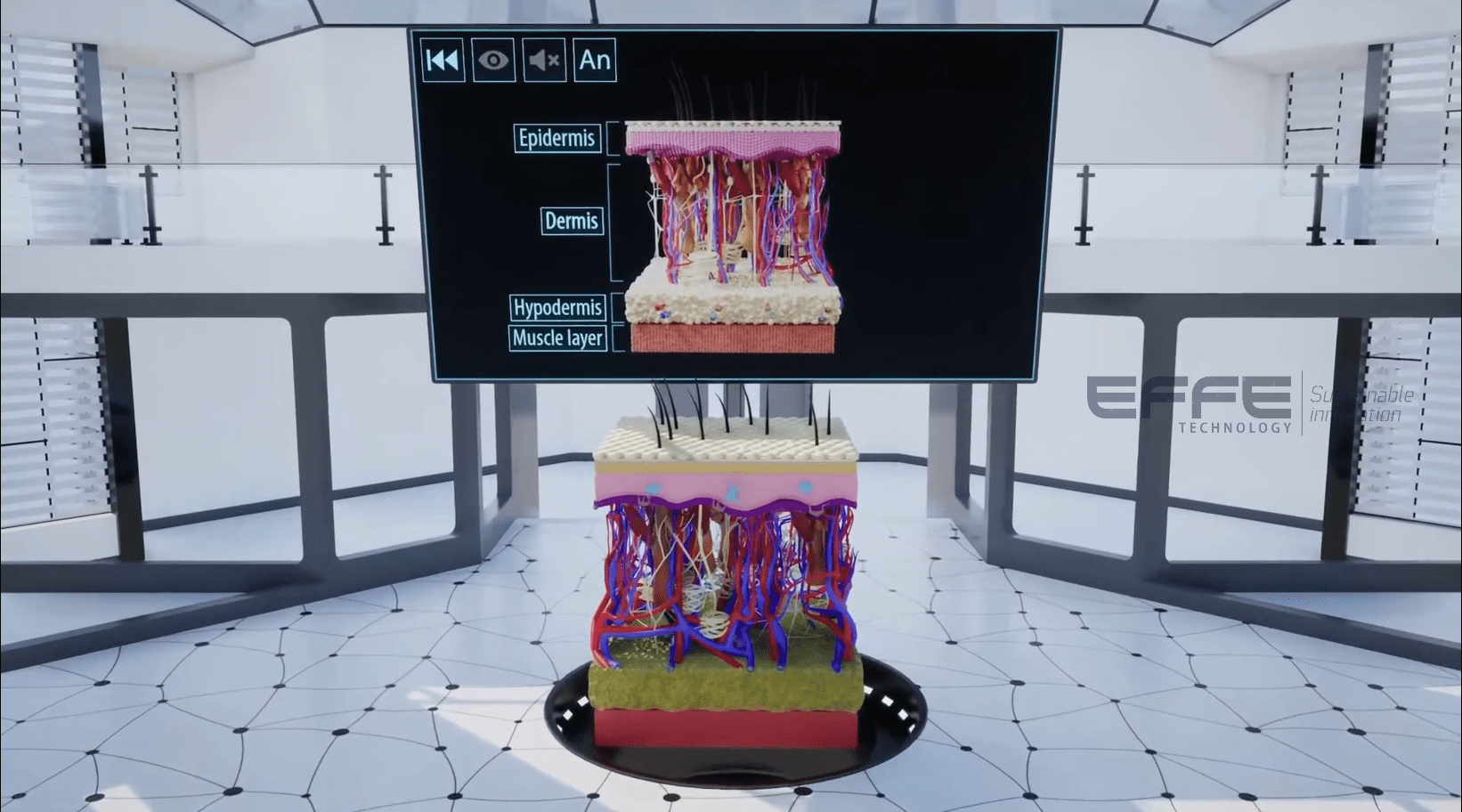
To bridge this gap, we developed an advanced integumentary system VR platform tailored for medical universities, dermatology departments, hospitals, and simulation labs. This immersive solution combines clinically aligned dermatology VR training with a high-fidelity 3D model of skin layers, allowing learners to explore epidermal, dermal, and subcutaneous structures in full 360° interaction.
The integumentary system VR platform empowers dermatologists, residents, cosmetologists, and medical students to visualize microstructures, understand pathological changes, and build procedural confidence in a safe, repeatable digital environment.
Project Requirement
The client required a scalable integumentary system VR solution that could:
- Deliver high-resolution dermatology VR training modules
- Present a detailed 3D model of skin layers with accurate labelling
- Demonstrate vascular, neural, and glandular structures
- Support academic teaching, CME programs, and simulation labs
- Enable pathology visualization (acne, psoriasis, dermatitis, burns)
- Provide measurable performance analytics
The core objective was to create a clinically reliable integumentary system VR ecosystem that enhances anatomical clarity, strengthens procedural preparedness, and supports institutional credibility.
Project Planning
Our planning phase focused on three pillars: anatomical precision, curriculum alignment, and long-term scalability.
We collaborated with dermatologists, anatomy professors, and clinical trainers to validate each structural layer inside the integumentary system VR environment. Every section of the 3D model of skin layers was mapped according to standard medical textbooks and surgical reference guides.
Key planning initiatives included:
- Structuring progressive dermatology VR training modules
- Designing interactive overlays for each skin layer
- Integrating cosmetic and clinical dermatology scenarios
- Building instructor dashboards for academic monitoring
- Ensuring compatibility across VR headsets used in medical simulation labs
This structured roadmap ensured that the integumentary system VR solution aligned with real-world dermatology education and hospital training standards.
Project Process & Execution
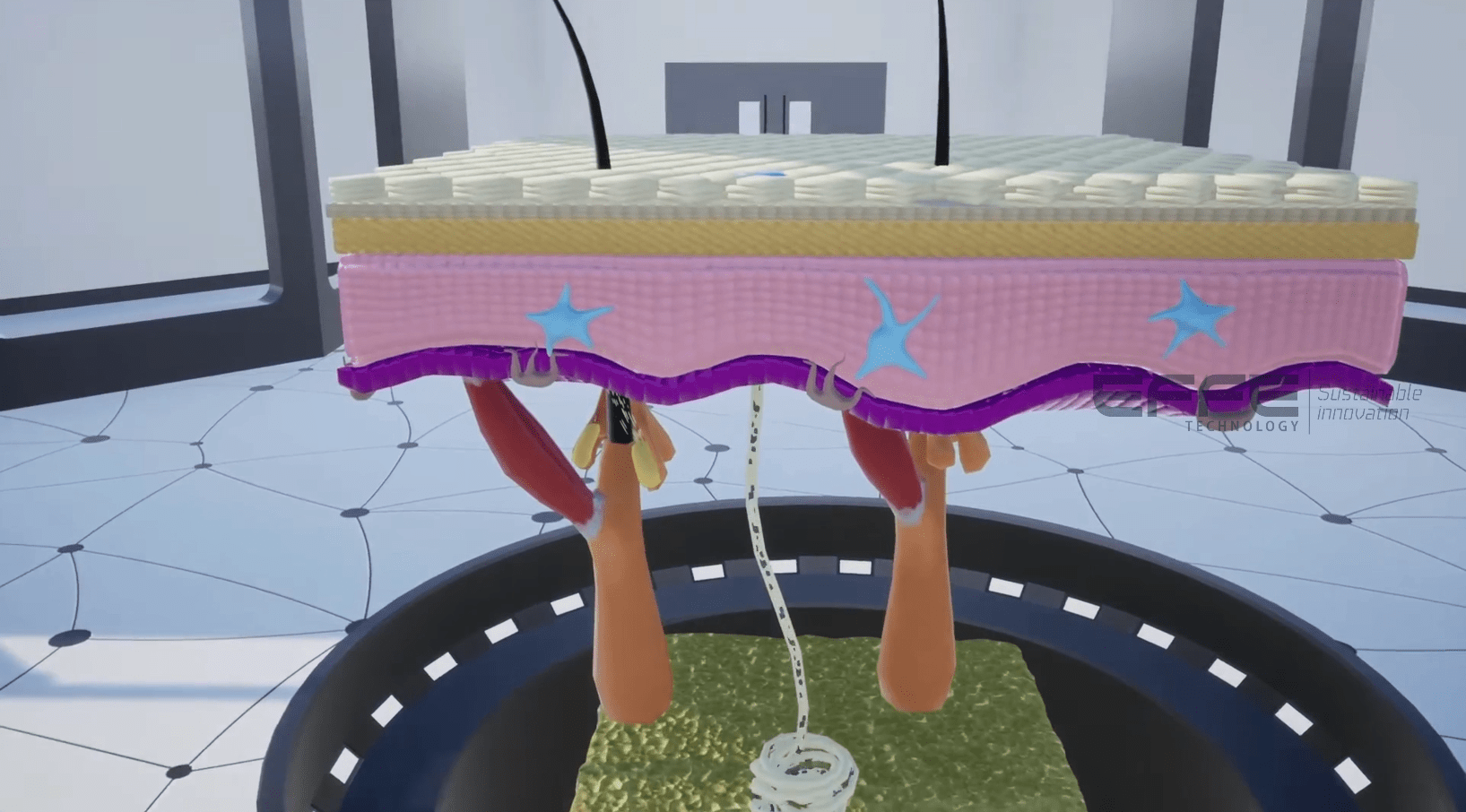
Using advanced 3D reconstruction tools and medically validated datasets, we developed a fully immersive integumentary system VR platform. The epidermis, dermis, hypodermis, hair follicles, sebaceous glands, sweat glands, nerve endings, and vascular networks were modeled with clinical accuracy.
Inside the VR environment, users can:
- Explore the 3D model of skin layers in 360° immersive space
- Isolate individual structures for focused dermatology VR training
- Zoom into microscopic layers to understand cellular arrangement
- Compare healthy and diseased skin conditions
- Visualize wound healing and inflammatory responses
- Participate in instructor-led guided modules
The integumentary system VR interface allows learners to rotate, dissect, and reconstruct skin anatomy virtually—significantly improving spatial understanding and knowledge retention.
Integrated analytics track engagement levels, module completion rates, and assessment performance, providing CMOs and department heads with measurable training insights.
Challenges & Learning
Micro-Anatomical Accuracy:
Reproducing fine structures such as nerve endings and microvasculature inside the 3D model of skin layers required multiple validation cycles with dermatology experts.
Balancing Depth with Usability:
Ensuring that the dermatology VR training modules remained academically rich while maintaining intuitive navigation demanded careful UX design.
Institutional Trust & Adoption:
Hospitals and universities required strong clinical validation before adopting the integumentary system VR solution. Structured assessments and faculty dashboards strengthened confidence and long-term deployment.
These refinements enhanced both credibility and user engagement.
Client Deliverables
- Fully immersive integumentary system VR platform
- Clinically validated dermatology VR training modules
- High-fidelity 3D model of skin layers with interactive labelling
- Pathology visualization and comparison tools
- Instructor dashboard with analytics and reporting
- Multi-user scalability for hospitals and universities
- Deployment, onboarding, and technical support
Conclusion
The integumentary system VR platform transforms dermatology education by combining anatomical precision with immersive interactivity. Through advanced dermatology VR training and a clinically accurate 3D model of skin layers, institutions gain a scalable, measurable, and future-ready learning solution.
For healthcare organizations, dermatology institutes, and medical universities, adopting integumentary system VR means investing in improved diagnostic understanding, enhanced procedural confidence, and technology-driven medical excellence.