
Overview
A deep understanding of gastrointestinal anatomy and physiology is essential for accurate diagnosis, safe endoscopic procedures, and effective surgical planning. However, textbooks, 2D diagrams, and static lab models often fail to provide the spatial clarity required in modern gastroenterology training.
To bridge this gap, we developed an immersive digestive system VR platform tailored for hospitals, GI & endoscopy centers, medical universities, and simulation labs. This solution combines high-fidelity virtual reality digestive system exploration with clinically aligned GI anatomy VR training, enabling learners to travel through the entire gastrointestinal tract in a fully interactive 3D environment.
The digestive system VR platform empowers gastroenterologists, surgical residents, medical students, and nursing professionals to visualize anatomical relationships, understand physiological processes, and strengthen procedural confidence in a safe and measurable digital space.
Project Requirement
The client required a scalable digestive system VR solution capable of:
- Delivering high-resolution virtual reality digestive system visualization
- Providing structured GI anatomy VR training modules for academic use
- Demonstrating the complete GI tract from oral cavity to rectum
- Supporting endoscopy-based anatomical understanding
- Visualizing digestive physiology, absorption, and pathology
- Enabling instructor dashboards with performance analytics
- Ensuring compatibility across medical simulation centers
The primary objective was to create a clinically credible digestive system VR ecosystem that improves conceptual clarity while supporting hospital-grade training standards.
Project Planning
Our planning phase focused on anatomical precision, curriculum alignment, and institutional scalability.
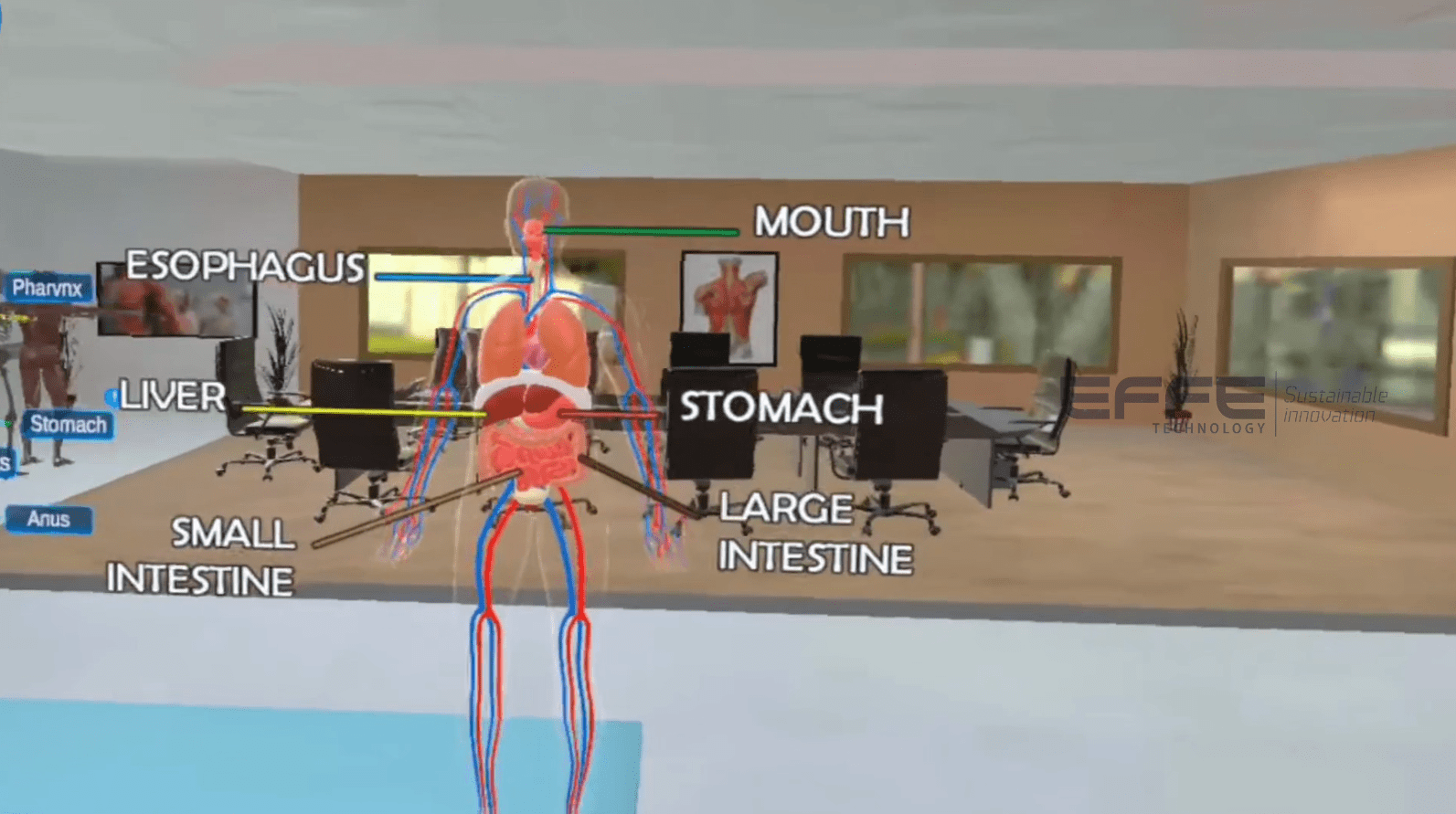
We collaborated with gastroenterologists, GI surgeons, anatomy professors, and simulation directors to validate every layer within the digestive system VR environment. Each structure—esophagus, stomach, liver, pancreas, small intestine, large intestine—was mapped according to surgical and endoscopic reference standards.
Key planning initiatives included:
- Structuring progressive GI anatomy VR training modules
- Designing interactive overlays inside the virtual reality digestive system
- Integrating physiology simulations (peristalsis, enzyme secretion, nutrient absorption)
- Building assessment dashboards for measurable academic outcomes
- Ensuring VR hardware compatibility for hospitals and universities
This structured roadmap ensured that the digestive system VR solution aligned with real-world gastroenterology education and clinical skill development.
Project Process & Execution
Using advanced 3D reconstruction tools and medically validated datasets, we developed a fully immersive digestive system VR platform.
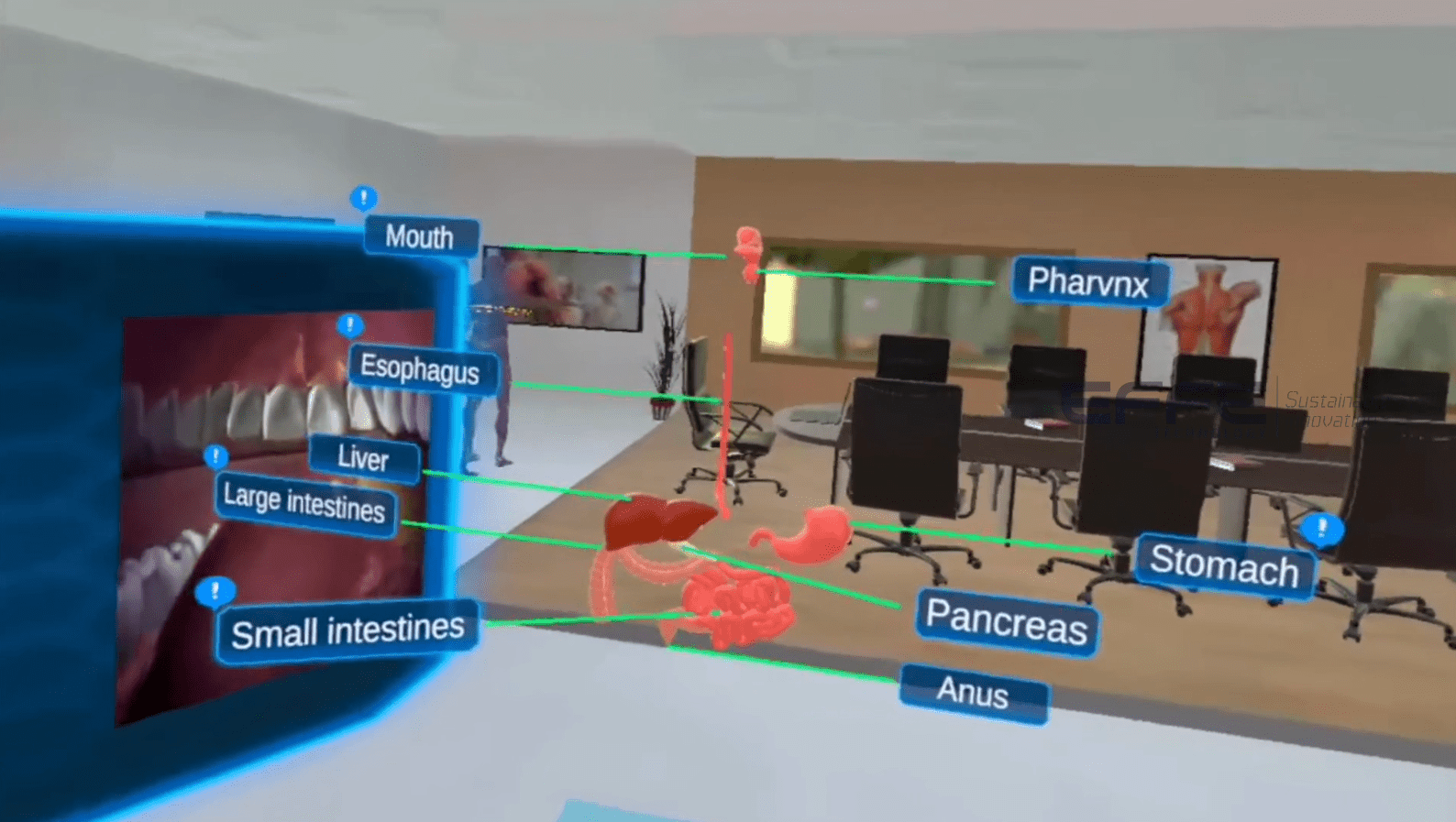
Inside the VR environment, users can:
- Explore the virtual reality digestive system in 360° immersion
- Travel through the GI tract in a guided walkthrough mode
- Isolate organs for focused GI anatomy VR training
- Visualize peristalsis, gastric acid secretion, and bile flow
- Compare healthy and pathological conditions (ulcers, GERD, polyps)
- Participate in instructor-led simulation sessions
The digestive system VR interface allows learners to zoom, rotate, and virtually dissect anatomical structures—improving spatial understanding and retention significantly.
Integrated analytics track module completion, assessment accuracy, and engagement levels, providing CMOs and academic heads with measurable performance data.
Challenges & Learning
Anatomical Depth & Accuracy:
Replicating the complexity of mucosal layers and vascular supply within the virtual reality digestive system required multiple validation cycles with GI specialists.
Balancing Education & Interactivity:
Ensuring that GI anatomy VR training remained academically rigorous while maintaining intuitive navigation demanded careful UX optimization.
Institutional Trust:
Hospitals and universities required clinically validated modules before adopting the digestive system VR platform. Structured assessments and faculty dashboards strengthened confidence and long-term deployment.
Client Deliverables
- Fully immersive digestive system VR platform
- Interactive virtual reality digestive system walkthrough modules
- Structured GI anatomy VR training curriculum
- Pathology comparison and physiology simulation tools
- Instructor dashboard with analytics and reporting
- Multi-user scalability for hospitals and medical universities
- Deployment, onboarding, and technical support
Conclusion
The digestive system VR platform transforms gastrointestinal education by combining anatomical precision with immersive interaction. Through advanced virtual reality digestive system exploration and structured GI anatomy VR training, institutions gain a scalable, measurable, and future-ready medical education solution.
For hospitals, GI centers, and medical universities, adopting digestive system VR means investing in stronger clinical understanding, improved procedural preparedness, and technology-driven healthcare excellence.