
Overview
Understanding cardiac anatomy is fundamental for every medical student, cardiology trainee, and healthcare professional. However, traditional methods such as textbooks, cadaver labs, and 2D images often limit spatial understanding and interactive exploration. This case study highlights how a heart anatomy VR simulation transformed cardiology education by creating an immersive, interactive, and clinically accurate virtual learning environment.
Designed for the Healthcare Education Industry and the Cardiology & Clinical Training Sector, this heart anatomy VR simulation empowers institutional decision makers with a scalable, future-ready training solution, while providing students and trainees with a hands-on, engaging learning experience. By combining virtual reality heart anatomy exploration with structured VR cardiology training, the platform bridges the gap between theory and real-world clinical application.
Project Requirement
The client required a comprehensive heart anatomy VR simulation platform that could:
- Provide accurate 3D visualization of cardiac structures
- Support interactive dissection and layer-by-layer exploration
- Enable immersive VR cardiology training for clinical understanding
- Allow multi-user collaboration for guided classroom sessions
- Integrate assessment tools and performance tracking
- Ensure compatibility across VR headsets, desktops, and simulation labs
The goal was not just visualization—but a clinically trusted virtual reality heart anatomy lab that enhances comprehension, retention, and confidence in cardiology education.
Project Planning
The planning phase focused on clinical accuracy, curriculum alignment, and usability. We collaborated with cardiologists, anatomy professors, and simulation coordinators to map essential learning objectives.
Key planning steps included:
- Structuring the heart anatomy VR simulation according to academic and clinical modules
- Designing interactive tools for rotation, scaling, isolation, and cross-sectional views
- Integrating real-case cardiology scenarios for practical VR cardiology training
- Ensuring anatomical precision in every virtual reality heart anatomy structure
- Planning scalable deployment for universities and training centers
This collaborative planning ensured that the solution met both institutional requirements and learner expectations.
Project Process & Execution
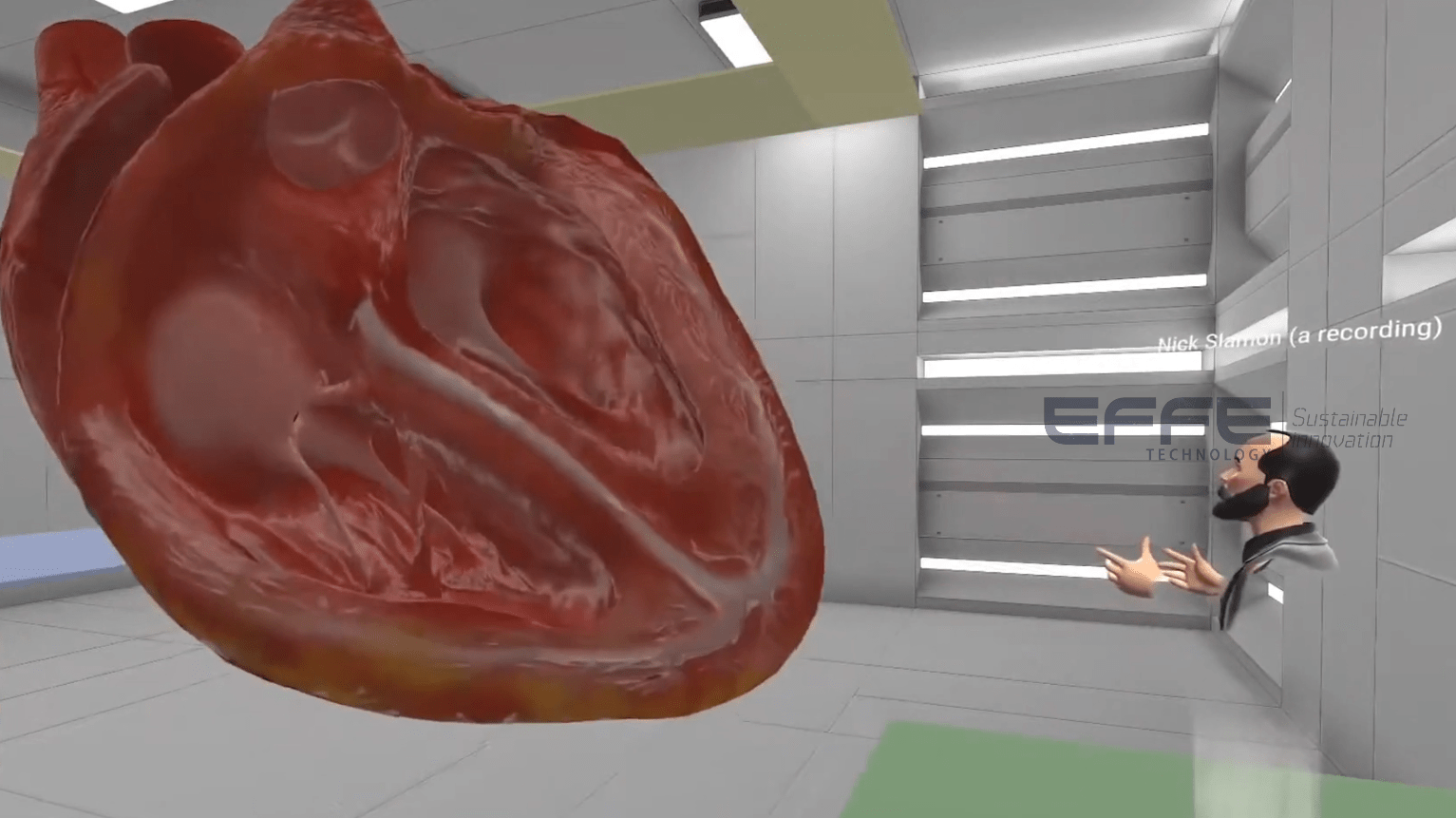
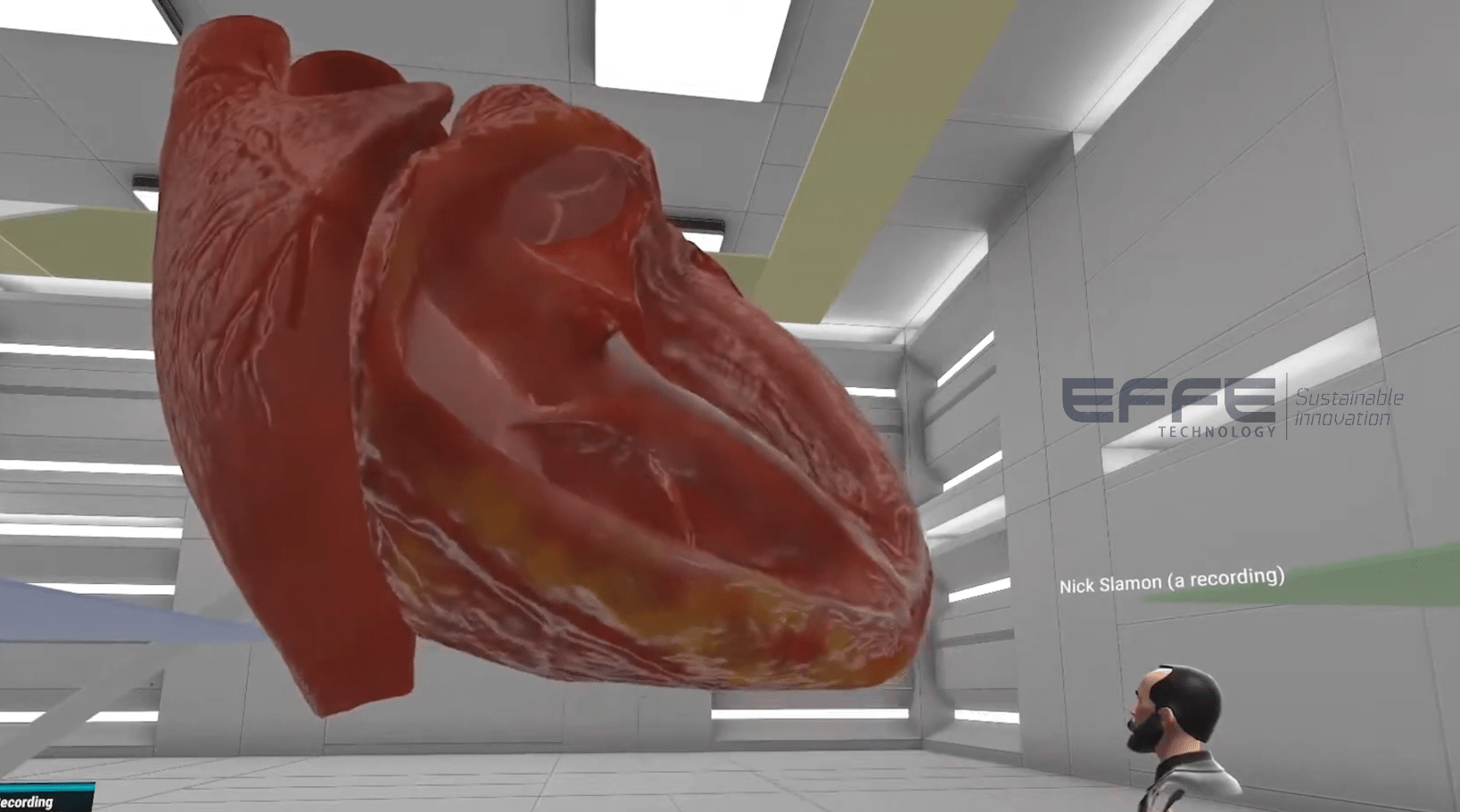
The execution phase involved transforming high-resolution anatomical data into a fully immersive heart anatomy VR simulation environment. Advanced 3D modeling techniques were used to reconstruct cardiac chambers, valves, arteries, veins, and conduction systems with exceptional clarity.
The platform enables users to:
- Explore the virtual reality heart anatomy in full 360° immersion
- Interact with structures through guided and self-paced modes
- Simulate blood flow and physiological processes
- Practice clinical understanding through structured VR cardiology training modules
- Participate in instructor-led multi-user sessions
By combining realism with interactivity, the heart anatomy VR simulation allows learners to experience cardiac structures in ways impossible with traditional learning tools.
Performance analytics were integrated to track user progress, helping institutions measure learning outcomes and improve curriculum delivery.
Challenges & Learning
Clinical Precision: Continuous validation with cardiology experts ensured anatomical accuracy within the heart anatomy VR simulation.
User Accessibility: Interfaces were optimized for both first-time VR users and advanced trainees.
Curriculum Integration: Aligning the virtual reality heart anatomy modules with academic standards strengthened adoption among institutions.
Scalability: The system was designed for deployment across multiple campuses and training centers.
These learnings reinforced trust, reliability, and long-term usability for healthcare institutions.
Client Deliverables
- Fully immersive heart anatomy VR simulation platform
- Structured VR cardiology training modules
- Interactive virtual reality heart anatomy exploration tools
- Multi-user instructor-led classroom mode
- Real-time performance tracking and analytics
- Cross-device compatibility and secure infrastructure
Conclusion
This project demonstrates how a heart anatomy VR simulation can redefine cardiology education. By integrating immersive virtual reality heart anatomy exploration with structured VR cardiology training, the solution delivers measurable improvements in understanding, retention, and learner confidence.
For institutional decision makers, it offers a scalable, future-ready training ecosystem. For students and clinicians, it provides a safe, repeatable, and engaging learning experience.
Through innovation grounded in clinical accuracy, this heart anatomy VR simulation builds trust, strengthens academic outcomes, and sets a new benchmark for immersive medical education.